The Enlightenment’s Gravediggers
When Westerners hate the West.
There is nothing that exists so great or marvellous / That over time mankind does not admire it less and less.—Lucretius
What have the Romans ever done for us?—Monty Python
It was as though he had been struck by a bolt of lightning, Jean-Jacques Rousseau would later recall in his autobiographical Confessions. The aspiring young philosophe from Geneva had been casually leafing through a copy of the literary magazine Mercure de France, while taking a brisk walk from Paris to Vincennes, when he stumbled upon an intriguing announcement. The distinguished Académie de Dijon was offering a prize for the best essay to answer the following question: “Has the reestablishment of the sciences and arts contributed to the purification of morals?”
This famous walk took place in 1749, at the height of the Republic of Letters: a vibrant community of intellectuals from across Europe who exchanged correspondence, wrote for periodicals, and mingled in salons to discuss radical new ideas. A few decades earlier, the Mercure de France had played a leading role in the famous Querelle des Anciens et des Modernes, the great debate about whether the modern age had surpassed the achievements of antiquity. By the end of the seventeenth century, the debate had been all but settled in favour of the moderns, thanks to the explosive advances of the sciences. But now the Académie de Dijon was posing a different and equally pressing question: Has all this undeniable scientific progress also led to moral improvement?
If our young philosopher had been astride a horse, he would almost certainly have tumbled off, much like Saint Paul during his conversion on the road to Damascus. Rousseau recounts, “Within an instant of reading this, I saw another universe and became another man.” In a feverish vision, he at once apprehended the innocence of humanity in its original state and the depravity of our civilisation. By the time he arrived at Vincennes, he was teetering on the brink of delirium. His response to the prize question—composed during sleepless nights and dictated from his bed to his secretary each morning—was a sweeping indictment of civilisation. Far from elevating and refining the human spirit, he argued, the advances in sciences and arts had corrupted and degraded it. Rousseau depicted a stark contrast between the blissful ignorance of primitive peoples and the vain sophistication and decadence of so-called “civilised” ones. Wherever the sciences flourished, he argued, virtue withered. Throughout history, civilisations inevitably crumbled under the weight of their own pointless knowledge and arrogant refinements, only to be overpowered by robust, untamed “barbarians.”
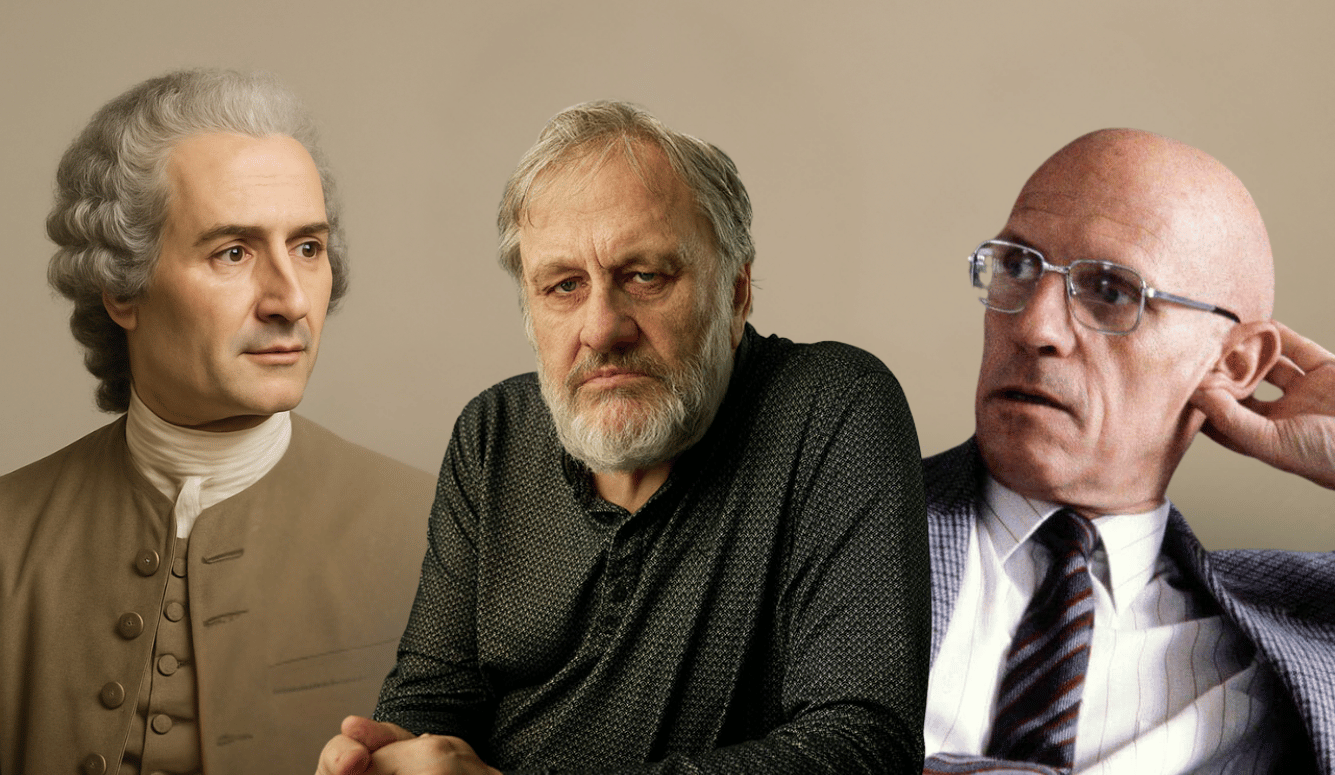
Rousseau’s first Discourse is one of the earliest instances of something that would come to accompany modernity wherever it gained a foothold: biting the hand that feeds you because you know it won’t punch you in the face. Just consider what’s going on here: An erudite and cultured philosopher pens a diatribe against the acquisition of knowledge, to be read by the intellectual elite of France and Europe. In eloquent prose that displays his knowledge of both ancient and modern history, Rousseau denounces refinement and scholarly pursuits. And yet Rousseau himself made significant contributions to Diderot and d’Alembert’s famed Encyclopédie, the crown jewel of the eighteenth-century French Enlightenment. As a gifted composer and musicologist, Rousseau wrote the bulk of the articles on music.
Diderot was still a close friend of Rousseau’s at this time, though they would later have a bitter falling-out. He not only proofread Rousseau’s essay but encouraged him to enter it for the competition. Was Diderot swayed by his Genevan friend’s indictment of civilisation? Not at all, but he relished the provocation: here was a leading encyclopaedist taking down the whole Encyclopédie project! Diderot’s open-mindedness encapsulates the Enlightenment in a nutshell—a profound appreciation for fearless self-criticism and for the relentless clash of ideas, even to the extent of inviting one’s adversaries to give one a thorough intellectual thrashing.
Rousseau predicted that his essay would be met with a “universal outcry against him,” and that only a handful of enlightened—or perhaps unenlightened—souls would truly grasp the force of his arguments. “But I have taken my stand, and I shall be at no pains to please either intellectuals or men of the world,” he declared. The irony is that the learned Académie awarded him the first prize.
To be sure, freedom of expression was still heavily restricted during Rousseau’s lifetime. Several Enlightenment thinkers ended up in prison for their subversive opinions or had to escape to more tolerant places like Switzerland or The Netherlands. The destination of Rousseau’s famous walk was, of all places, the Vincennes prison, where his friend Diderot was behind bars for his atheist views. Yet, the Enlightenment thinkers had carved out a little sanctuary of free thought for themselves, a space where they had nothing to fear, since they were among friends. Rousseau knew that Diderot and d’Alembert would not send a mob after him because he had besmirched the Encyclopédie. So what could be safer than biting that particular hand? Better still, it enabled Rousseau to portray himself as a courageous truth-seeker challenging prevailing dogmas.
The Modern Aversion to Modernity
The French philosopher Pascal Bruckner once quipped that “Nothing is more Western than hatred of the West.” As early as 1945, George Orwell noted that “there is a minority of intellectual pacifists, whose real though unacknowledged motive appears to be hatred of Western democracy and admiration for totalitarianism.” After the Second World War, Western academic institutions spawned one school after another to denounce or undermine Western civilisation. Postmodernists like Michel Foucault and Jacques Derrida attacked the “logocentrism” of Western rationality and attempted to deconstruct the narrative of scientific and moral progress. Followers of the Frankfurt School of Critical Theory wrote devastating critiques of the European Enlightenment. Its delusional project to quantify, rationalise, and dominate the world, they claimed, had paved the way for National Socialism and the Holocaust. Social constructivists exposed modern science as just one mythological narrative among many. Science, they argued, did not so much reveal reality as construct its own reality—and an oppressive one at that. Postcolonial thinkers denounced Western civilisation for its colonialism and cultural imperialism. Environmentalists argued that Western modernity is ravaging nature and upsetting the delicate balance of our planetary climate. The industrial revolution that originated in Western Europe, they claim, may turn out to have been humanity’s most fateful blunder.
Every evil in the world—racism, slavery, colonialism, greed, imperialism, exploitation, sexism, environmental destruction, patriarchy, homophobia—has been laid at the doorstep of Western civilisation, often by intellectuals who enjoy all the benefits of living in the West.
As Douglas Murray documents in The War on the West, all over the Western world, left-wing activists are knocking Western heroes like Winston Churchill and Abraham Lincoln off their pedestals—often literally. Statues have been smeared with paint, monuments have been demolished, museums and curricula have been “decolonised.” The campus protests against Israel are less about antisemitism than about a hatred of Western civilisation. For the protestors, Israel represents the West’s last “settler-colonial” project. Columbia University’s Students for Justice in Palestine proudly proclaimed: “We are Westerners fighting for the total eradication of Western civilization.” This echoes something Stokely Carmichael said in the 1960s: “When you talk of black power, you talk of building a movement that will smash everything Western civilization had created.”
Although over the past decades leftists have been more creative in inventing ever more novel ways of denouncing Western civilisation, the efforts of the Right should not be discounted, either. In fact, radical environmentalism originated on the Right. A century ago, those who bewailed the befoulment of nature by factory smoke, coal mines, and railroads, and believed industrialisation was humanity’s biggest mistake, were mostly blue-blooded toffs who wanted to use nature for their own recreation and for hunting game. Environmentalism only crossed the political aisle in around the 1970s. Moreover, conservative intellectuals have long lamented that modern society is undermining traditional family values, ripping communities apart, and eroding religious faith, and they often laud the values of premodern cultures over those of our own society.
There is also a rich tradition of right-wing thinkers in the West cozying up to foreign dictators, theocrats, and military strongmen, who are sworn enemies of western civilisation and its liberal values. This august tradition of right-wing fellow travelling has recently been revived by Donald Trump, who openly expresses admiration for totalitarian dictators like Vladimir Putin, Xi Jinping, and Kim Jong-un, and who, when questioned about Putin’s murderous regime, gave an answer that any student of Noam Chomsky could have rattled off: “You think our country’s so innocent?” Both the far Left and the far Right now believe that Russia was “provoked” into invading Ukraine by the “aggressive” expansion of NATO.
Moynihan’s Law
So, where does all this Western self-loathing come from? Is there something about Western modernity that sows the seeds of its own discontent? It is curious that some of these intellectual currents—especially on the Left—sprang from the Enlightenment itself, with its long tradition of merciless self-criticism. In this sense, this school of thought resembles an intellectual autoimmune disorder, in which the immune system starts to attack the body’s own cells.
Some thinkers, including the aforementioned Pascal Bruckner, argue that Western self-abasement is rooted in the Christian religion. According to Christianity’s doctrine of Original Sin, we are all irredeemably tainted by evil, and pride—believing that you are better than other people—is the worst of the seven cardinal sins. Christian believers are constantly told that they should express remorse at their sinfulness and depravity. Moreover, Jesus stood up for the weak, the outcasts, and the downtrodden. Could this be the psychological origin of the Western intellectuals’ strange habit of pretending that their civilisation is the root of all evil?
Personally, I think the Western penchant for vilifying our own civilisation has a more straightforward explanation: only a free and affluent civilisation like ours permits people to vilify it. Where else can you take your own political leaders to task in public, even insult and abuse them, without fear of repercussions? You shouldn’t try it in Russia or China, just as you shouldn’t have tried it in Europe before the rights revolution and the liberal constitutions of the nineteenth and twentieth centuries. Similarly, where are you free to wage a full-frontal attack on the economic and political institutions under which you live? Where can you make a fuss about problems both real and imaginary? Only in a liberal democracy.
But why would you want to bite the hand that feeds you in this way? Such critics have a variety of motives, but perhaps for many, the main appeal is that in doing so they feel they are striking a heroic posture. In a Western democracy, you can pat yourself on the back for courageously “speaking truth to power,” you can even complain about being silenced and censored, while the very fact that you are able to voice these complaints out loud proves them hollow. It’s the intellectual equivalent of a soccer player theatrically flopping down onto the field to feign injury.
In economic terms, this is a supply-side explanation. Kvetching and griping are always in demand. In Monty Python’s Life of Brian, the leader of the Popular Front of Judea asks indignantly, “What have the Romans ever done for us?” But of course he does so in a secret meeting, without any Romans within earshot.
Our free society, unlike the Roman one, offers almost unlimited opportunities to openly voice such complaints with impunity: “What has the Enlightenment ever done for us?” Nowhere else in the world, and at no other previous time in history, have people ever had so much freedom to bite the hand that feeds them without being punched in the face for it. This leads to a paradox that was probably first described by American diplomat Daniel Patrick Moynihan:
The amount of violations of human rights in a country is always an inverse function of the amount of complaints about human rights violations heard from there. The greater the number of complaints being aired, the better protected are human rights in that country.
If you find yourself in a society where everyone seems satisfied with the current institutions and nobody openly complains about corruption or oppression, you should get the hell out of there as quickly as possible. Chances are that you’re living in a totalitarian dystopia. If, on the other hand, people around you are constantly griping that their freedoms are being trampled and their leaders are corrupt, and declaring that the whole political system should be smashed to the ground, you should heave a sigh of relief. You have found a free society.
Moynihan’s law highlights a contrast between open and closed societies, but it can also apply to the same society at different points in its history. Over time, as societies become freer, human rights organisations gain more access to information and enjoy more freedom to do their work, which allows them to uncover more abuses. This can give rise to the illusion that things are getting worse, when the exact opposite is true. In a country that guarantees freedom of the press and has mechanisms to make government information public, such as a Freedom of Information Act, any corruption that does exist is more likely to be brought to light. The political scientist Kathryn Sikkink calls this the information paradox. As ex-Muslim Ibn Warraq writes, “the openness of Western societies means that our ills and squalor are exposed publicly, while the worst in Islamic societies is hidden from infidels.” Warraq, not coincidentally, published his own book, Why I Am Not A Muslim, with a Western publisher, and even in the West, he needs the cover of a pseudonym to protect him from the wrath of his co-religionists.
Coddling Your Enemies
Free societies often grant a platform to their own worst enemies. In 2013, while Syrian dictator Bashar al-Assad was suffocating his own people with poison gas and President Obama was considering launching a military intervention to stop him, Assad’s patron Vladimir Putin was given a column in the op-ed pages of the New York Times, in which he lectured the West about the rules of international law. Didn’t Western leaders understand, cautioned Putin, that violating Syria’s territorial integrity without a mandate from the UN Security Council (where Russia has veto power) would amount to a blatant act of aggression, in violation of the UN Charter upholding the peaceful international order? Six months later, Putin’s army brutally annexed the Crimea in Ukraine, in preparation for a full-scale invasion of that sovereign democratic country. I wonder if Putin would be willing to give western leaders a column in Izvestia—controlled by the Kremlin—to express their concerns about this.
Attitudes towards Israel provide a striking illustration of Moynihan’s Law and the information paradox. As in other Western countries, Israeli newspapers, NGOs, and ordinary citizens are free to criticise, insult, and even vilify their leaders, and even to take legal action against their executive government. Israeli civil society has a long and admirable tradition of taking the government to task.
Among the pro-Palestinian Left, this very openness is constantly touted as proof that the country is uniquely rotten. An endless series of articles in the Western media have taken the following angle: “Even Israelis admit that their country is an apartheid state and is committing genocide in Gaza!” These critics fail to understand that this freedom to criticise the government is precisely what sets the country apart from its neighbours. Few Palestinians—and few Arabs elsewhere in the Middle East—feel safe enough to express harsh criticism of their own leaders. Openly dissident Palestinians exist, but almost all of them live in Western cities and/or publish in Western newspapers. The fact that more self-critical voices reach us from Israel than from Gaza or Lebanon is not a sign that things are worse over there, but precisely the opposite. Israeli society still has the ability to engage in self-criticism and course-correct when necessary.
Biting the hand that won’t punch you has long been a favourite pastime of Western intellectuals. In 1942, Austrian economist Joseph Schumpeter noted that, for the intellectual elite, condemnation and rejection of capitalism is “almost a requirement of the etiquette of discussion”:
Whatever his political preference, every writer or speaker has to conform to this code and to emphasise his critical attitude, his freedom from “complacency,” his belief in the inadequacies of capitalist achievement, his aversion to capitalist and his sympathy with anti-capitalist interests.
Nothing equivalent existed in the communist countries. Openly expressing your aversion to Marxism from behind the Iron Curtain would have meant social opprobrium at best—but more likely the gulag. Communist sympathisers in the West, however, were free to vilify their own societies, while glorifying the totalitarian alternative they never had to suffer under. Most were savvy enough to remain hypocrites: they returned from brief visits to Stalin’s Russia or Mao’s China raving about the glorious future they supposedly witnessed there, but only the truly deluded actually packed their bags for Moscow or Beijing.
Anti-Western critics often like to pretend that their bravery will be met with “universal outcry against them,” but with a few exceptions (such as the McCarthy era), these crusaders are given free rein. In fact, they are often handsomely rewarded for their voracious hand-biting, at least within their own social circles.
In a wonderfully scathing letter of 1935, British socialist and feminist Sylvia Pankhurst takes George Bernard Shaw to task for such ungrateful posturing. Shaw had enthusiastically supported Benito Mussolini’s “Corporate State” in Italy—even though he thought it rested on flimsy premises—because he hoped it would hasten the downfall of capitalism at home. Meanwhile, Shaw dismissed freedom in his own country as a “putrefying corpse.” Pankhurst tells him:
At least in the non-Fascist countries, most of us are able to do propaganda for our convictions, as you and I do. If you lived in Italy, you would not be permitted to do any propaganda, except on behalf of the ruling clique. You would not be permitted to say that [Italy’s] Corporate State is a ‘scrap of paper and an explosion of gas.’ There are men and women in the dungeons and on the penal islands of Italy for saying just that very thing, and I warrant if you say it long enough, you will not be permitted to go to Italy for your holidays, nor will your plays any longer be permitted there. Dare to write about it in the ‘Times,’ and this will be the result.
Even after the Cold War ended and most of the world’s communist regimes collapsed, biting the nourishing hand of industrial modernity remained a favourite pastime of leftist intellectuals. Postmodernists and critical theorists launched countless attacks on Western civilisation, while ensconced in cushy positions at Western universities, and Western presses published their books. A conference in the humanities can sometimes feel like a Mexican birthday party, in which blindfolded children take turns to whack a piñata until it bursts and sends candy flying everywhere—with Western modernity being their piñata. This faux-radical posture has become a hackneyed tradition of its own. As Tom Wolfe put it half a century ago: “Radical Chic, after all, is only radical in Style; in its heart it is part of Society and its traditions.”
A seminal example is the late Palestinian-American theorist Edward Said, one of the most influential intellectuals of the twentieth century and an unremitting scourge of Western civilisation. In Orientalism, Said excoriates Western thinkers for their systematic prejudices about non-Western cultures, and decries the West’s centuries-old desire to conquer and subdue the Orient. From Homer and Plato onwards, Said argues, Western thinkers have imagined the Orient as exotic, sensual, mysterious, feminine, and irrational, in order to sharpen their own self-image as rational, dominant, and masculine. Said had little interest in an even-handed account of the different prejudices civilisations harbour about each other; his ire was almost exclusively focused on the West. Even today, argued Said, Western political and academic institutions are deeply complicit in the imperialist project to dominate and erase the Oriental other.
But surely if orientalist and Islamophobic prejudices had been as deep-rooted at Western universities as Said argued, there would have been a “universal outcry against him”? In fact, throughout his long career, Said was rewarded with numerous prizes, awards, and distinguished professorships at universities like Berkeley, Yale, and Johns Hopkins. Orientalism was not originally published in the Orient: it rolled off the Western presses and it was the Western intellectual elite who gave it the imprimatur of a modern classic.
Even in Israel, a country that Said relentlessly attacked, Orientalism became required reading at universities, especially among the younger generation. By contrast, after Said had a falling-out with Palestinian leader Yasser Arafat, his books were banned in the West Bank and Gaza—despite Said’s indefatigable commitment to the Palestinian cause. There could scarcely be a more striking contrast between a hand that allows itself to be bitten and one that strikes back.
Another example of such revolutionary posturing is the immensely popular Slovenian philosopher Slavoj Žižek, renowned for making edgy arguments such as “Better the worst Stalinist terror than the most liberal capitalist democracy,” and for stating that Adolf Hitler was “not violent enough” because his violence was not sufficiently “essential.” If anyone in Josef Stalin’s Soviet Union had dared to write that he preferred the worst capitalist exploitation over the most perfect communist paradise, he would probably have been whisked off to the gulag—or summarily shot. But, as the Dutch-Somali writer Ayaan Hirsi Ali once told a fashionably anti-Western journalist: “You grew up in freedom and you can spit on freedom because you do not know what it is like not to have freedom.”
Ironically, many anti-Western intellectuals received succour from the very hand they were biting. French postmodernist Michel Foucault wrote numerous books and articles decrying the cruelties and sinister power dynamics supposedly underpinning “enlightened” modern institutions like schools, prisons, hospitals, and mental asylums. The more morally enlightened something appeared, the more Foucault relished reducing it to a vehicle of power and domination. But when he was dying of AIDS, Foucault was cared for at the Hôpital de la Pitié-Salpêtrière, the very same institution that occupies centre stage in his work Madness and Civilisation. With his signature cynicism, Foucault described the humanitarian reforms that took place at La Salpêtrière after the French Revolution as a sinister exercise in bourgeois power discourse that was hardly better than medieval cruelties. Even the anti-colonial revolutionary theorist Frantz Fanon was flown to a hospital in Washington, DC by the “imperialist” CIA to receive cutting-edge treatment for his leukaemia.
Canaries in the Coal Mine
Don’t get me wrong: I would not want to live in a society in which no one can afford to bite the hand that feeds them. Tolerance of relentless self-criticism is precisely what made the Enlightenment so successful. In that sense, we should indeed “love our enemies,” as Jesus counselled. We should cherish the naysayers. The more mud they fling, the better. Anti-capitalists, postmodern relativists, and Putin apologists are canaries in the free speech coal mine—we should start worrying if they suddenly fall silent.
Still, although self-criticism is important if we want to learn from our mistakes, ritual self-flagellation is not just unproductive but actively harmful, especially when it involves glorifying alternatives that would make all of us much worse off. A healthy body needs a robust immune system to protect it from infections, but if that immune system is overzealous, it will wreak the body’s destruction. Enemies of liberal democracy like Vladimir Putin, Xi Jinping, and Ayatollah Khamenei must be rubbing their hands with glee as they watch us disarm ourselves without a fight. They don’t even have to denounce our free societies—we’ve already indicted ourselves.
Although this may appear to be a battle between defenders and critics of the West, there is nothing exclusively Western about modernity. The Enlightenment is an immensely powerful collection of ideas, which happen to have originated in some corners of Western Europe in the seventeenth and eighteenth centuries, but which have universal appeal and have since taken root in many different cultural and geographical settings. In fact, non-Westerners like Ayaan Hirsi Ali are often especially appreciative of the blessings of liberal democracy and industrial modernity because they have had first-hand experience of what it means to be deprived of them. It’s only those who have enjoyed freedom and prosperity their whole lives who tend to behave like spoiled brats.
[First published at Quillette, June 19, 2025)
Here’s a podcast interview I did about my essay at Human Progress.


"I just created a video against the evils of globalisation, just wait a sec while I upload it so that anyone anywhere in the world can immediately see it" - it is easier maybe with a joke to say how much I agree with this, coming from Eastern Europe and for a longe time enjoying the common will of Rousseau , the double standards are really striking, no, one journal article rejected is non censorshiop, having to learn english and french in quebec or catalan and spanish in Barcelone is not linguistic tyranny and not resprecting the environment enough for building something isnot worse than environtmentally friendly camps in the colds of siberia