
The Bar That Disappeared
How I Read A Confidential Memo on Live TV

Two weeks ago, I was invited onto Flemish public television (VRT) to discuss a survey on rising intolerance among young people. Before going on air, I obtained an internal VRT presentation. Buried in the margins was a note that was not meant for my eyes to see: journalists were instructed not to report one of the most striking findings in the dataset.
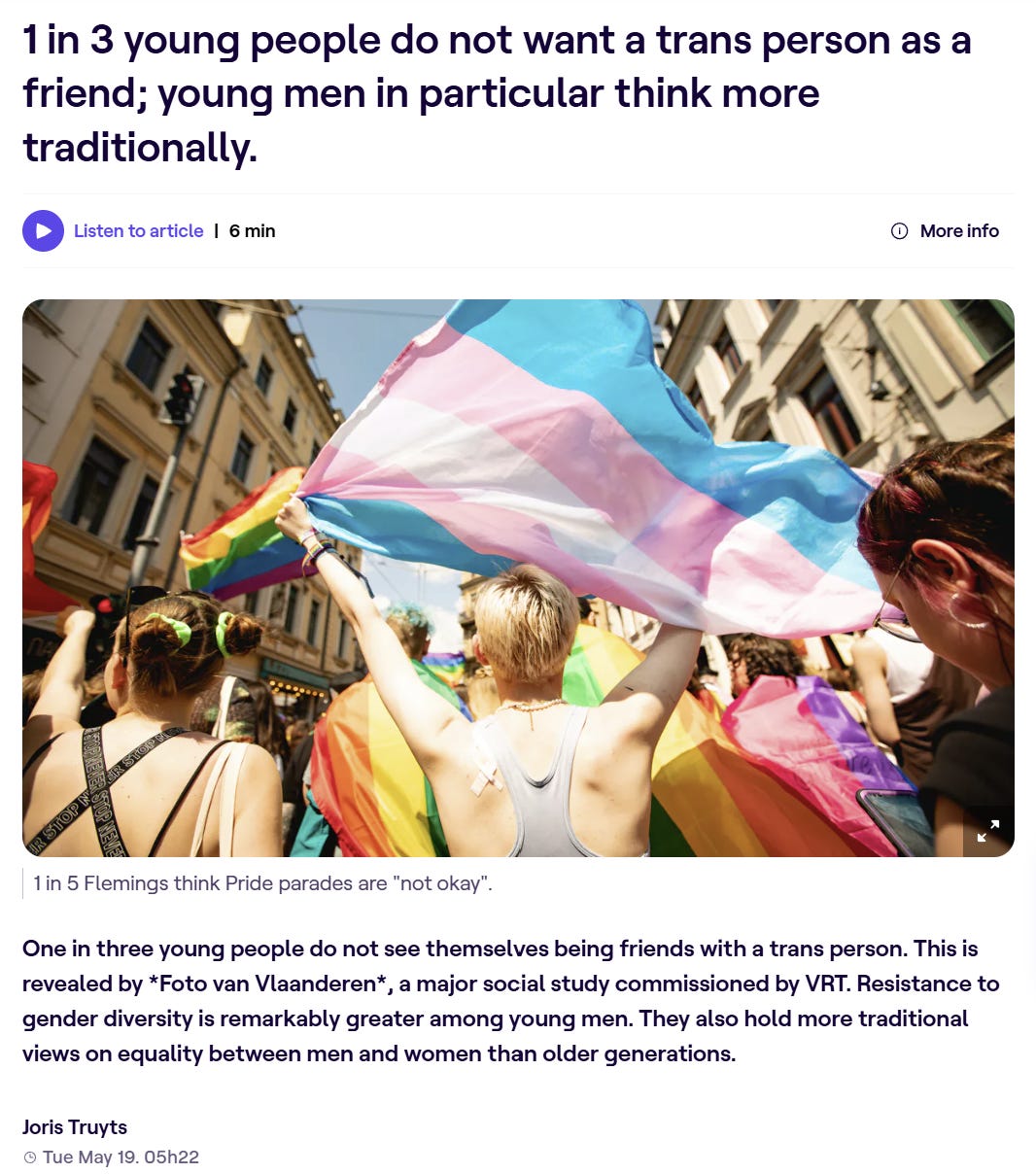
Here’s what happened. VRT’s research department had conducted a survey called De Foto van Vlaanderen (“The Picture of Flanders”), which it carries out every few years to measure the social temperature of our region. This year’s edition led to wall-to-wall coverage across VRT outlets about some supposedly shocking findings among young people: growing intolerance towards LGBTQ people and a rise in conservative values. The headline finding was that 17% of Flemish children aged 12–17, and 16% of those aged 18–44, agreed that there are circumstances in which men are allowed to hit women. One in three youngsters said they wouldn’t want a trans person in their friend group.
The manosphere?
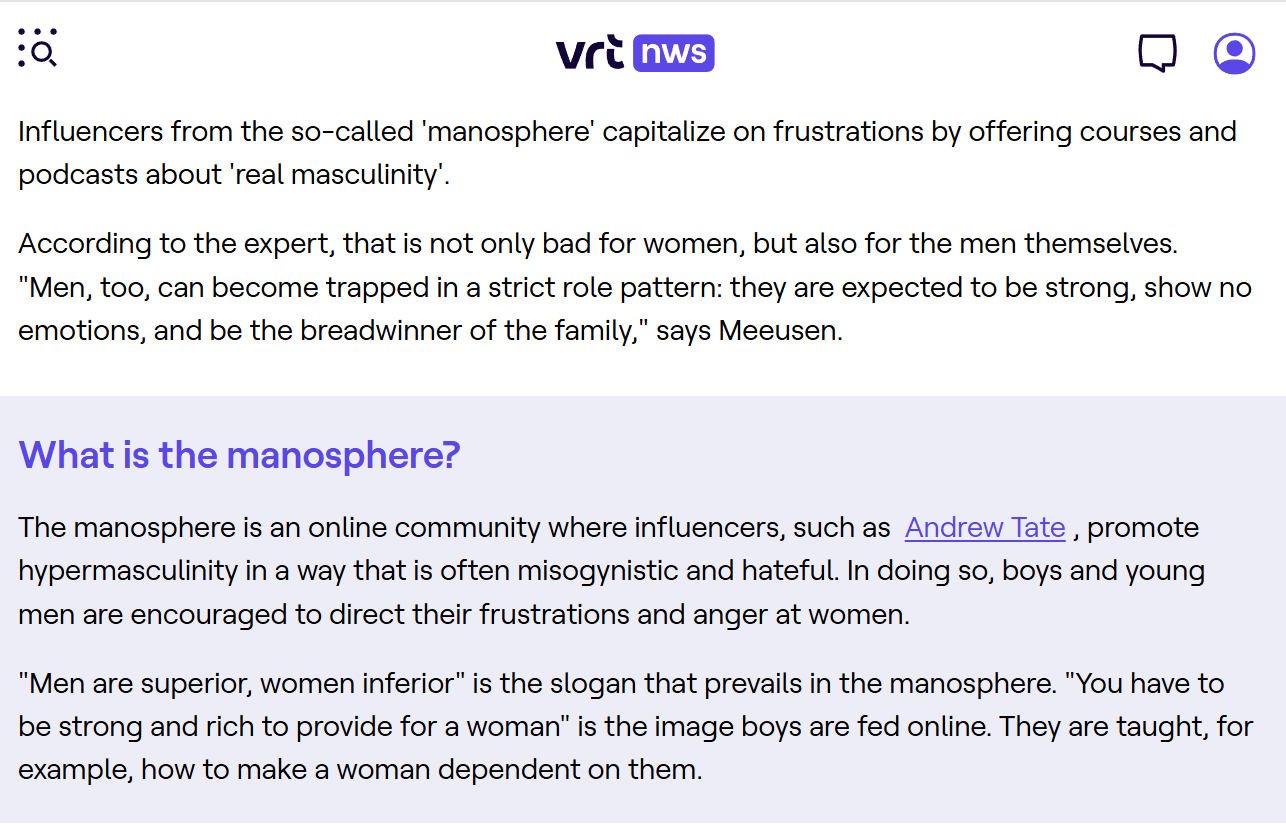
VRT’s editorial framing, supported by a range of experts and talking heads, was immediate and uniform. The villain was the so-called “manosphere”: young boys falling under the spell of Andrew Tate and other social-media influencers, adopting their brand of toxic masculinity and misogyny. So VRT invited me onto the current-affairs programme De Afspraak to discuss the findings alongside a sexologist.
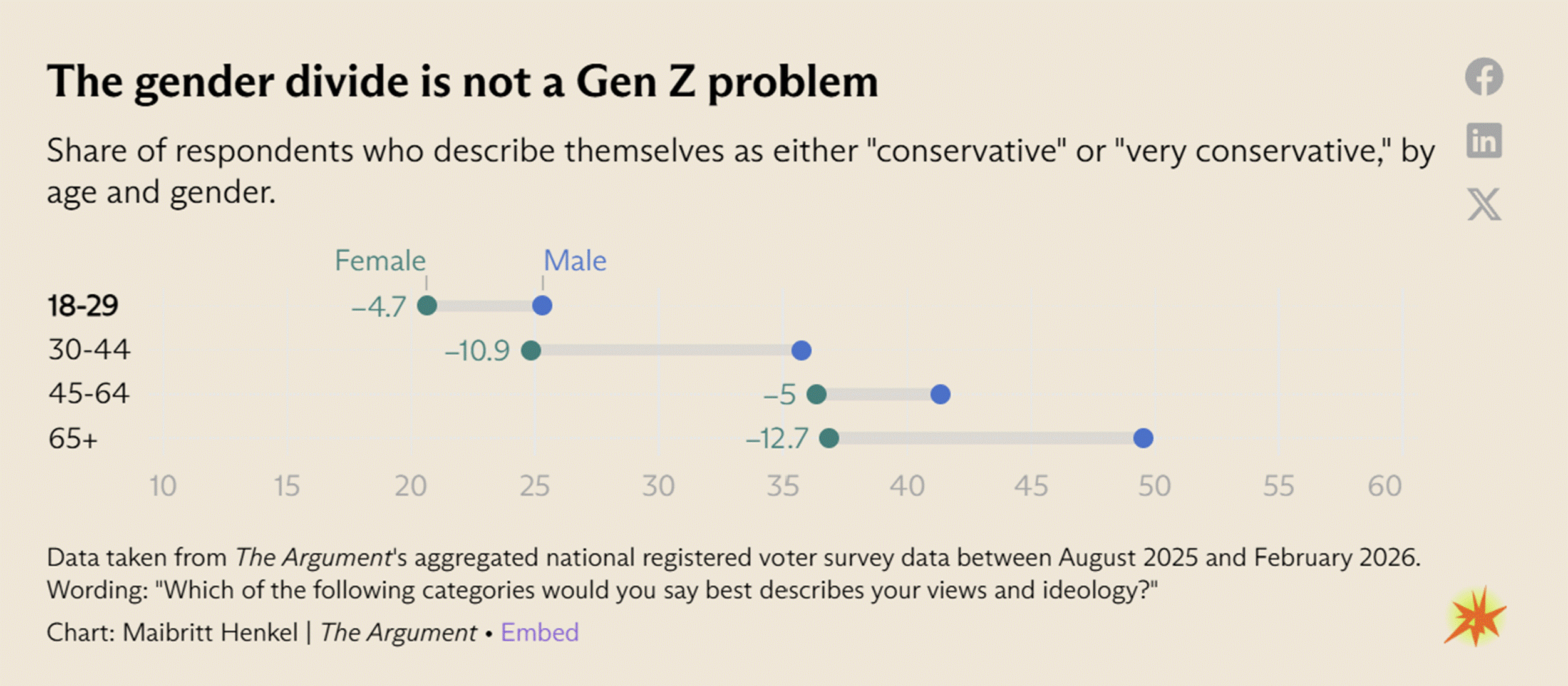
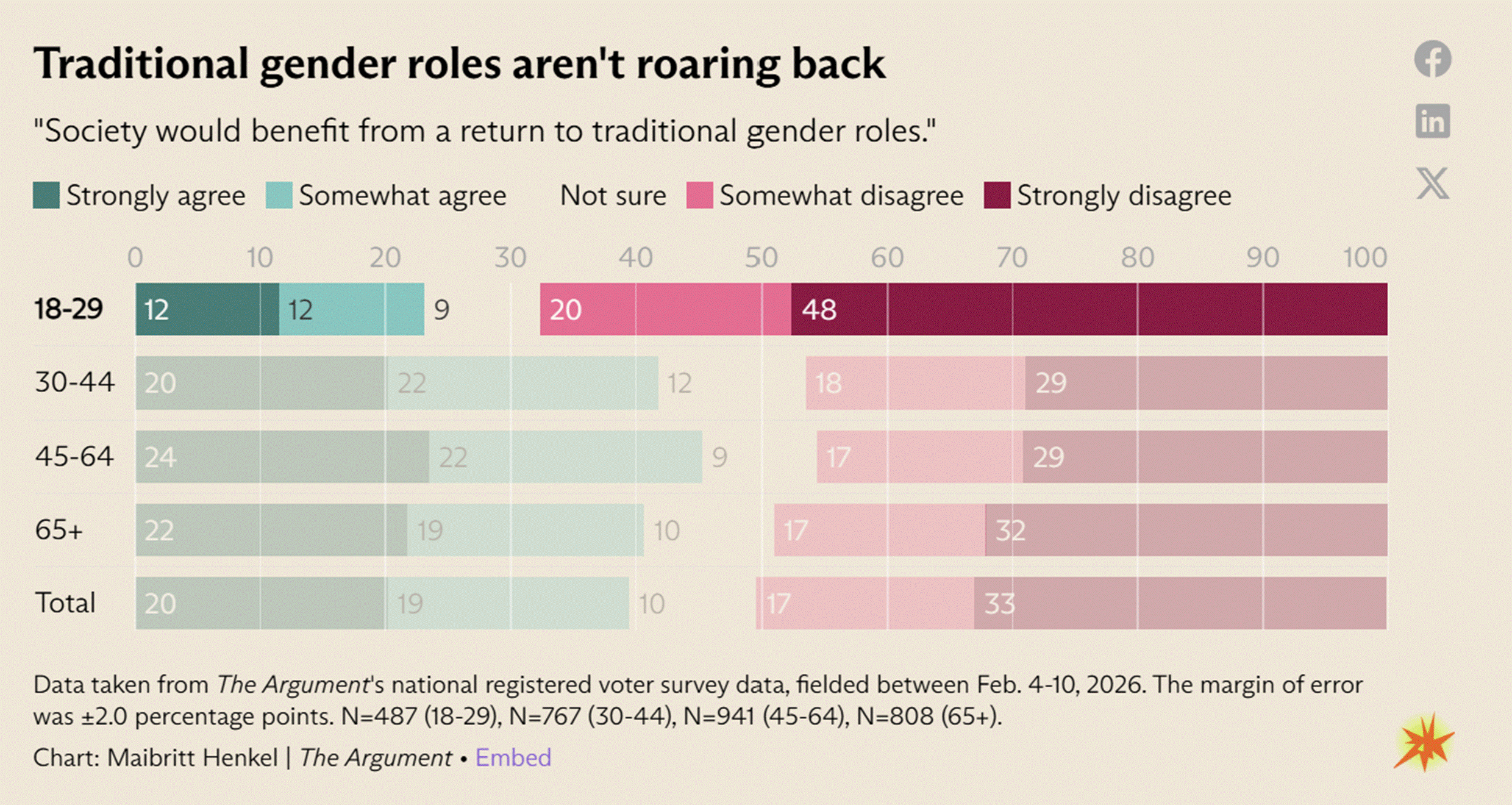
I must admit that I was sceptical about the findings right away. Andrew Tate is a pretty nasty piece of work, but the whole narrative surrounding the “manosphere” is starting to resemble a moral panic among the liberal elite. In any event, the data on the radicalization of young boys are far less clear than is often suggested, as a recent piece in The Argument shows:
In response to every question we asked about changing gender norms, younger men were more progressive than Gen X or boomer men. Just like with women, men under the age of 45 tended to hold more liberal views than older men.
To the extent there is a growing gender gap among Gen Z, it seems to be driven by young women swinging to the left, not men moving to the right:

Ignoring religion
But what about the role of religion, particularly Islam, which has been shown to exert a major influence on gender intolerance, even after controlling for education and income? There was only a brief mention of conservative religion, buried deep in the article and immediately downplayed. Everyone reached for the same script about the rising manosphere and the generational divide.
So naturally, I asked for access to the full report before going on air. I couldn’t get it. That, together with the uniform narrative pushed by VRT, made me a little suspicious. Why invite an expert onto television if you’re not prepared to share the data?
Eventually, a young editor shared a brief PowerPoint presentation used for internal circulation. To my surprise, there was in fact a bar for “foreign origin” in all the charts, alongside the age and education categories. Less surprisingly, this bar was the highest of all. The internal presentation even highlighted the high levels of intolerance among foreigners several times.
But then I noticed a comment in the margin from a VRT editor that was clearly not meant for my eyes. It instructed the VRT news desk not to report the breakdown by foreign origin, even though that data had been collected. The stated reason? The category was not sufficiently “representative” of foreigners and was slightly too highly educated. And lo and behold, that bar did indeed disappear from all the published news stories.
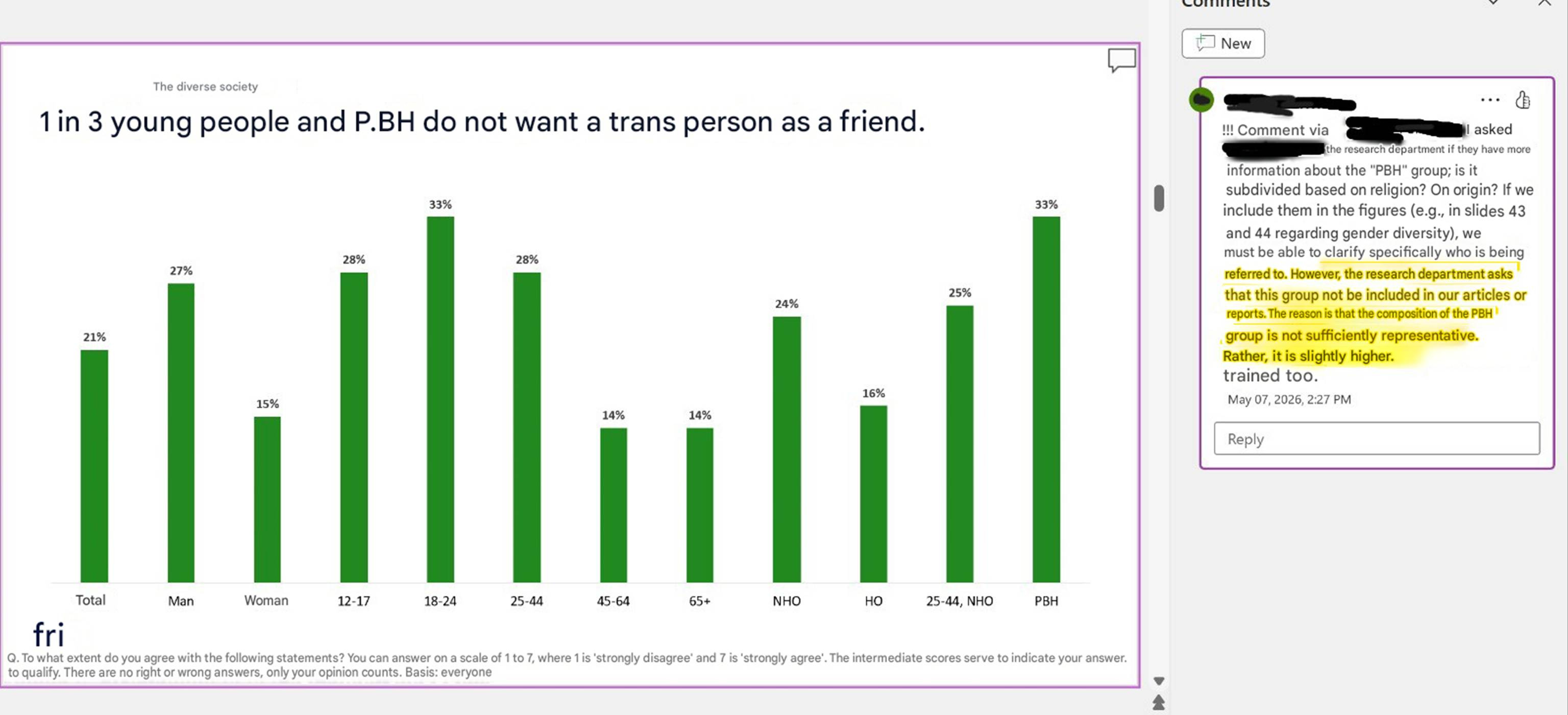
At this point I was getting annoyed and decided to ambush my hosts. During the broadcast, I pulled an A4 printout of that screenshot from my back pocket and read it out loud. Long story short: the clip went viral, the minister of media got involved, and Flanders spent the past two weeks arguing about the affair. Here’s the full episode (item starting at 17:30):
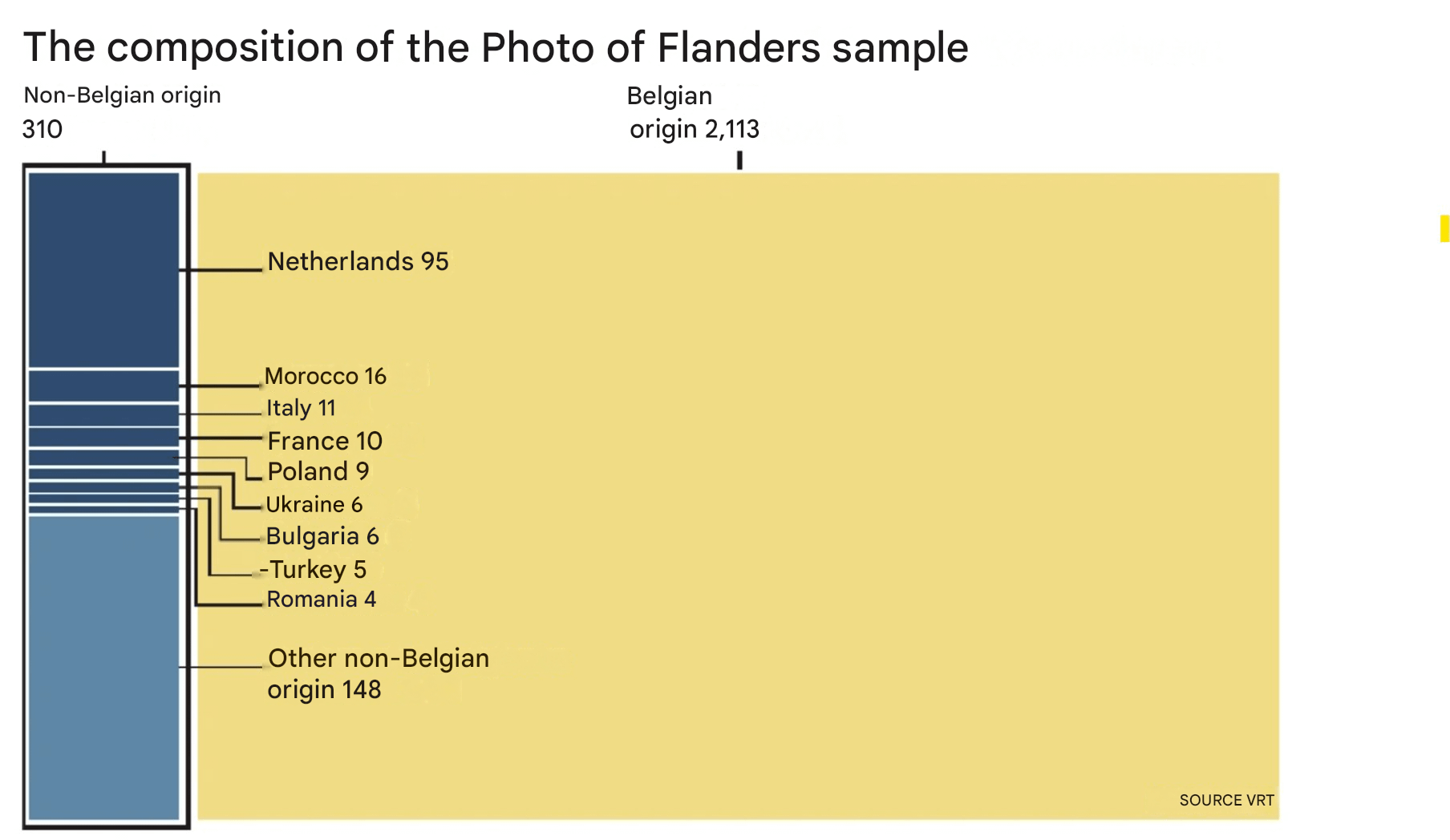
At first, VRT issued a public statement addressing the charge that it had deliberately omitted inconvenient data about origins. Their justification was that there were too many Dutch people in the group classified as foreigners. Apparently, they had used a catch-all category called “foreign origin”, and among those 310 respondents, no fewer than 95 were Dutch. Yet even with this dilution of the data, the “foreign origin” group still scored substantially higher on LGBT intolerance than native Belgians.
OK, but why not simply exclude those Dutch nationals? Or just compare European and non-European migrants separately? Nope. Instead VRT instructed its journalists to quietly drop those bars from the news reports.
A prediction
Since they still refused to cough up the data, despite all the political pressure, I ventured a prediction, as a good Popperian: VRT was sitting on uncomfortable data about migration—and Islam in particular—and was reluctant to make it public.
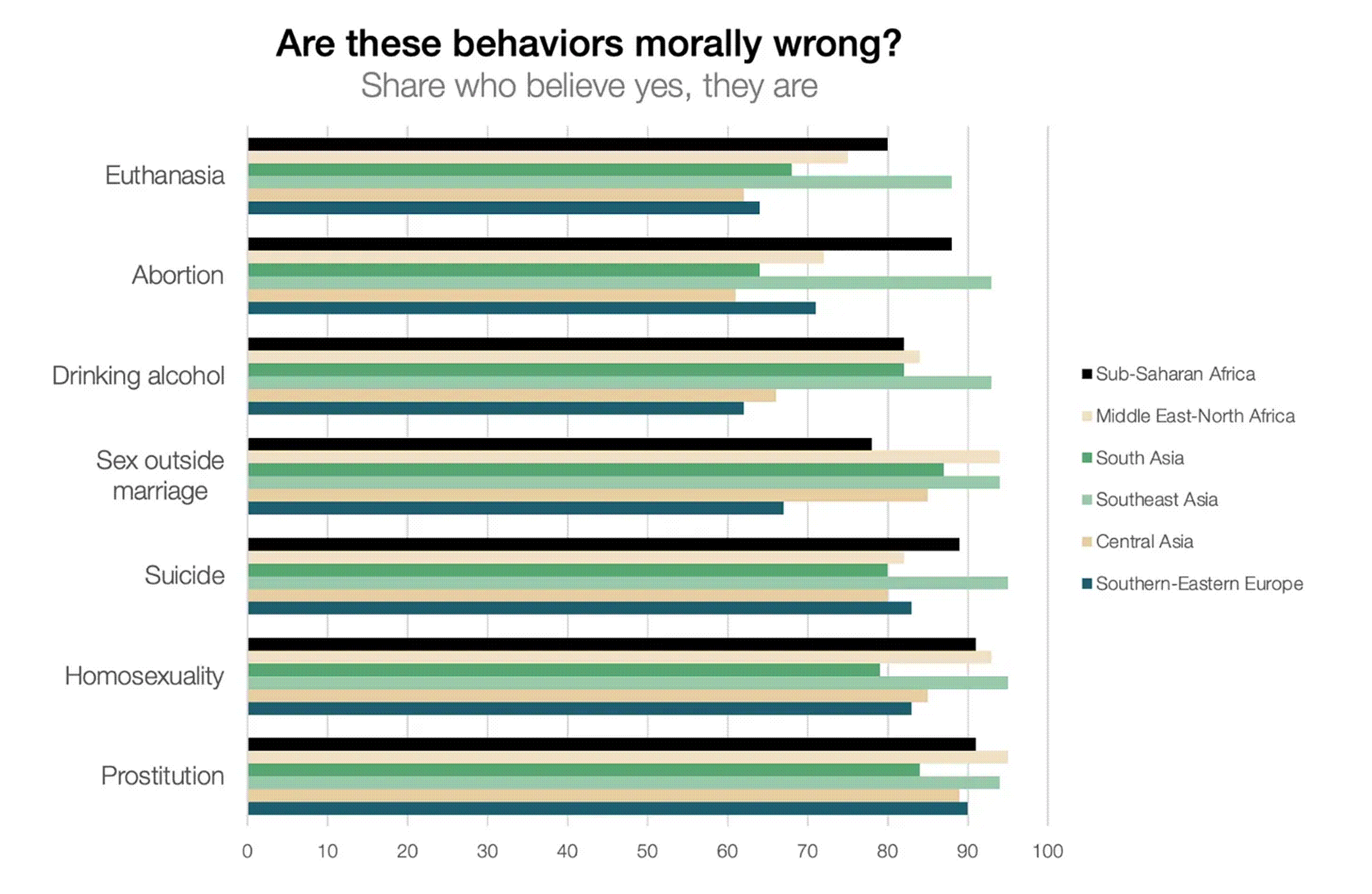
This was not a very risky prediction. Decades of research show that homophobia tracks religiosity, with Islam high on the list (see Tomas Pueyo’s recent series of posts, which contains a wealth of data). Globally, about 85% of Muslims believe that homosexuality is morally wrong:
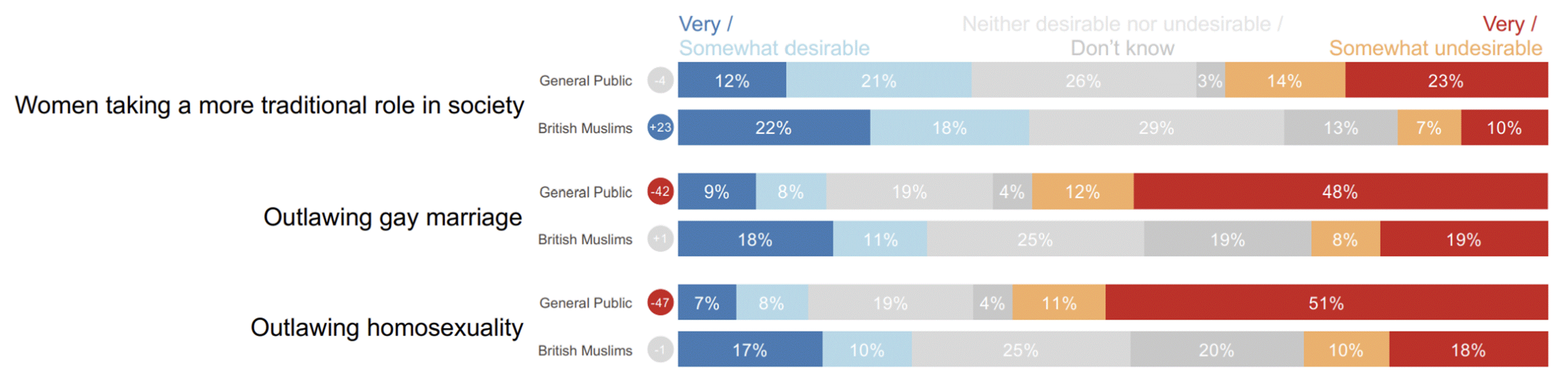
27% of British Muslims want to outlaw homosexuality:
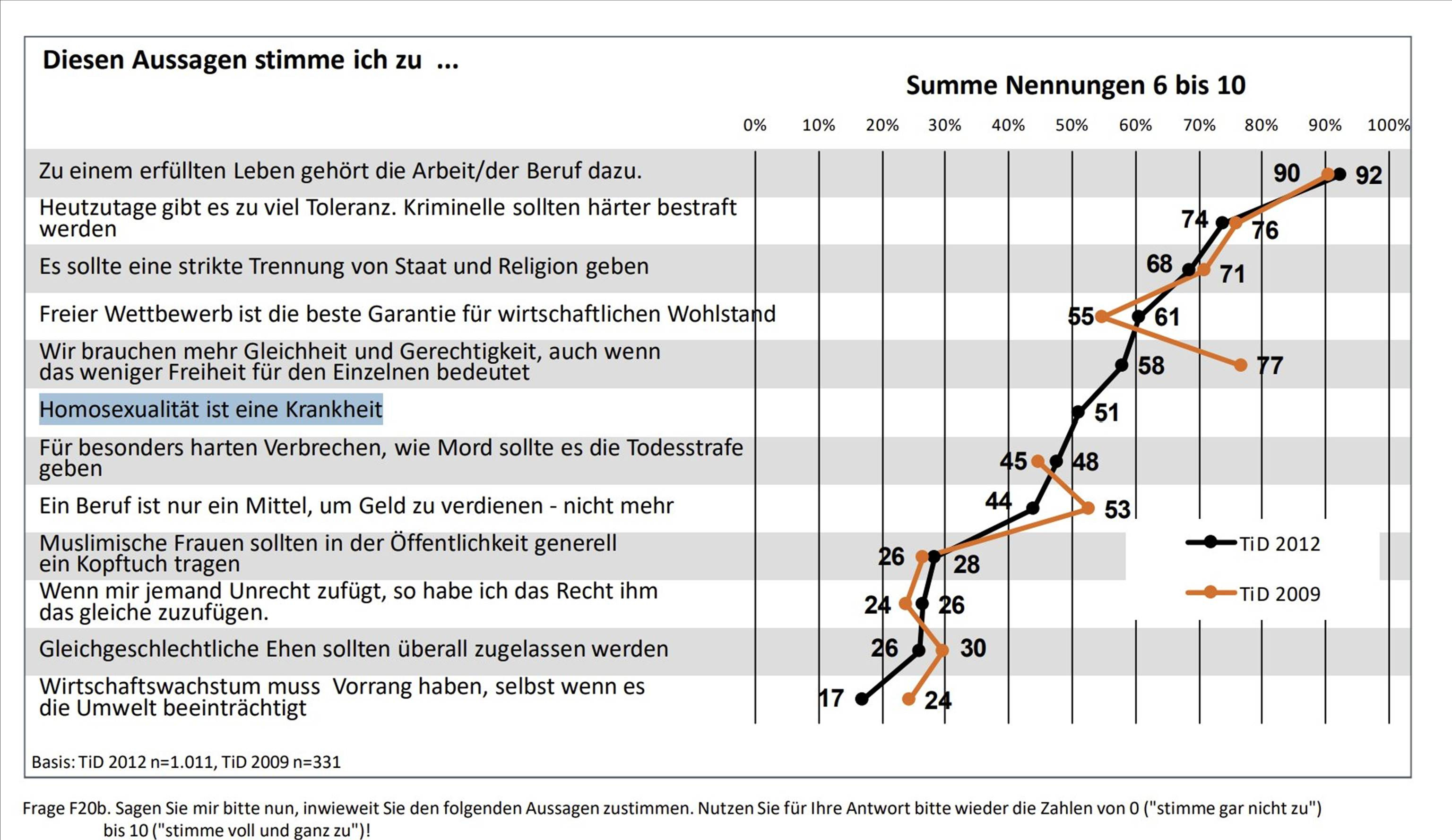
Half of Turks in Germany consider homosexuality a “disease”:
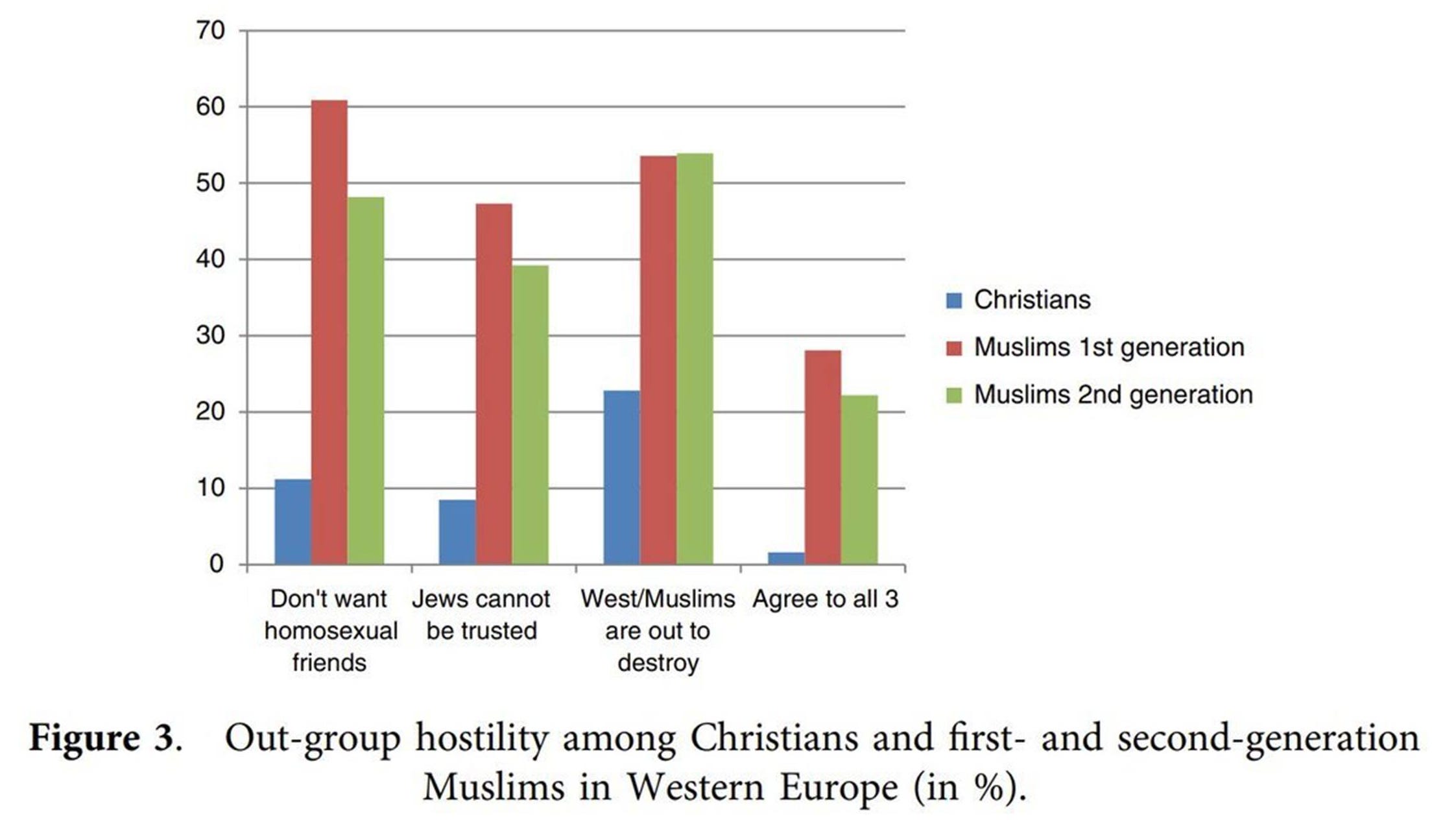
Half of European Muslims don’t want to have gay people as friends:
And a quarter of young Muslims in Belgium say violence against gay people is justified (JOP Monitor).
These attitudes towards homosexuality and the role of women follow a religiosity gradient among both Muslims and Christians: the more devout, the more intolerant. The difference is that the baseline level of intolerance is much higher among Muslims.
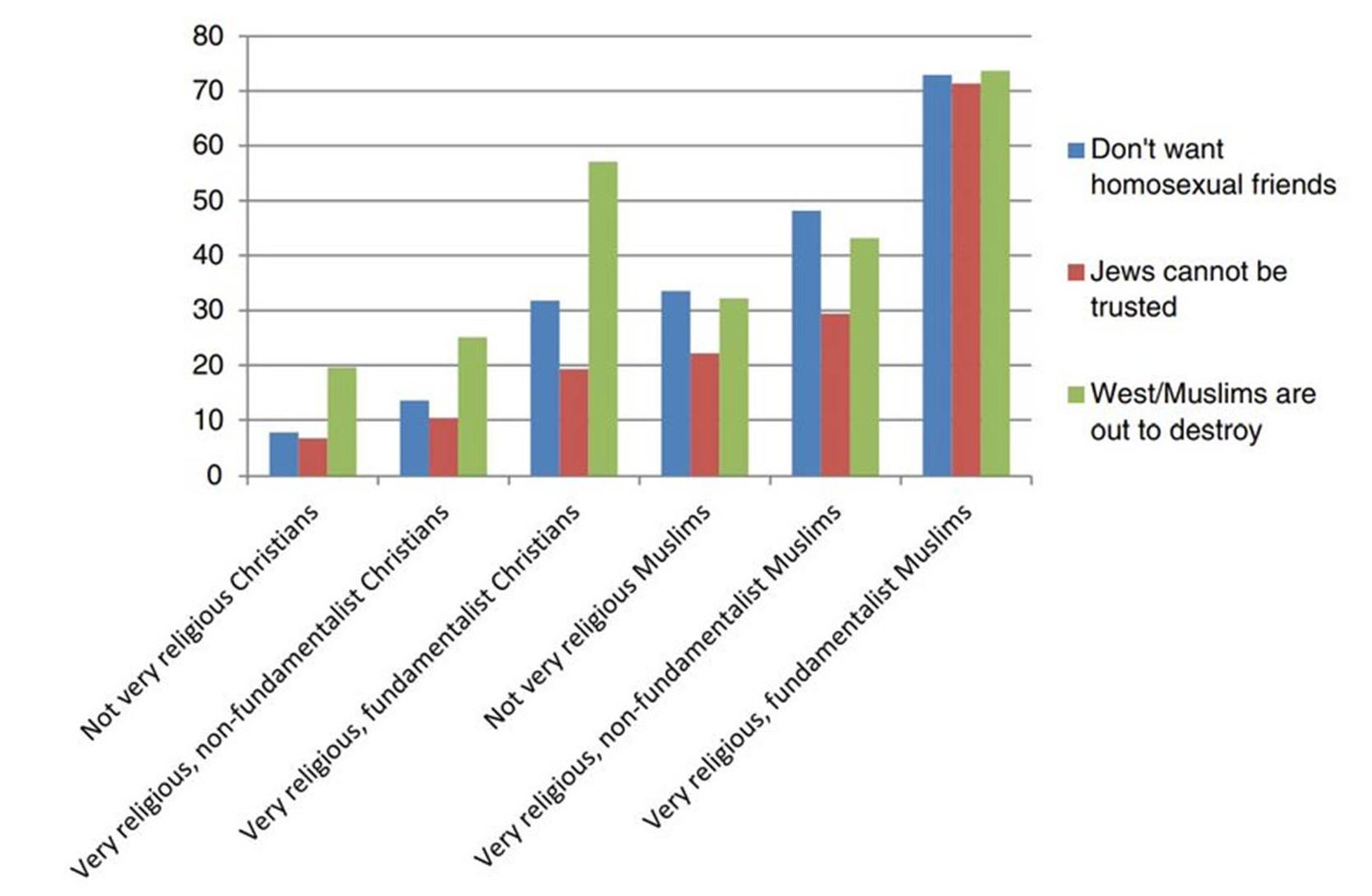
All of this was true long before the rise of the—admittedly reprehensible—manosphere, which VRT promoted as the explanation of the day.
The data finally released
When the VRT finally caved in to pressure to release the data—to a select group of scientists who had to show up at the VRT offices on a weekday—I solicited the help of my friend Freek Van de Velde, a computational linguist from Leuven University. He carried out a statistical analysis and wrote a report about the results.
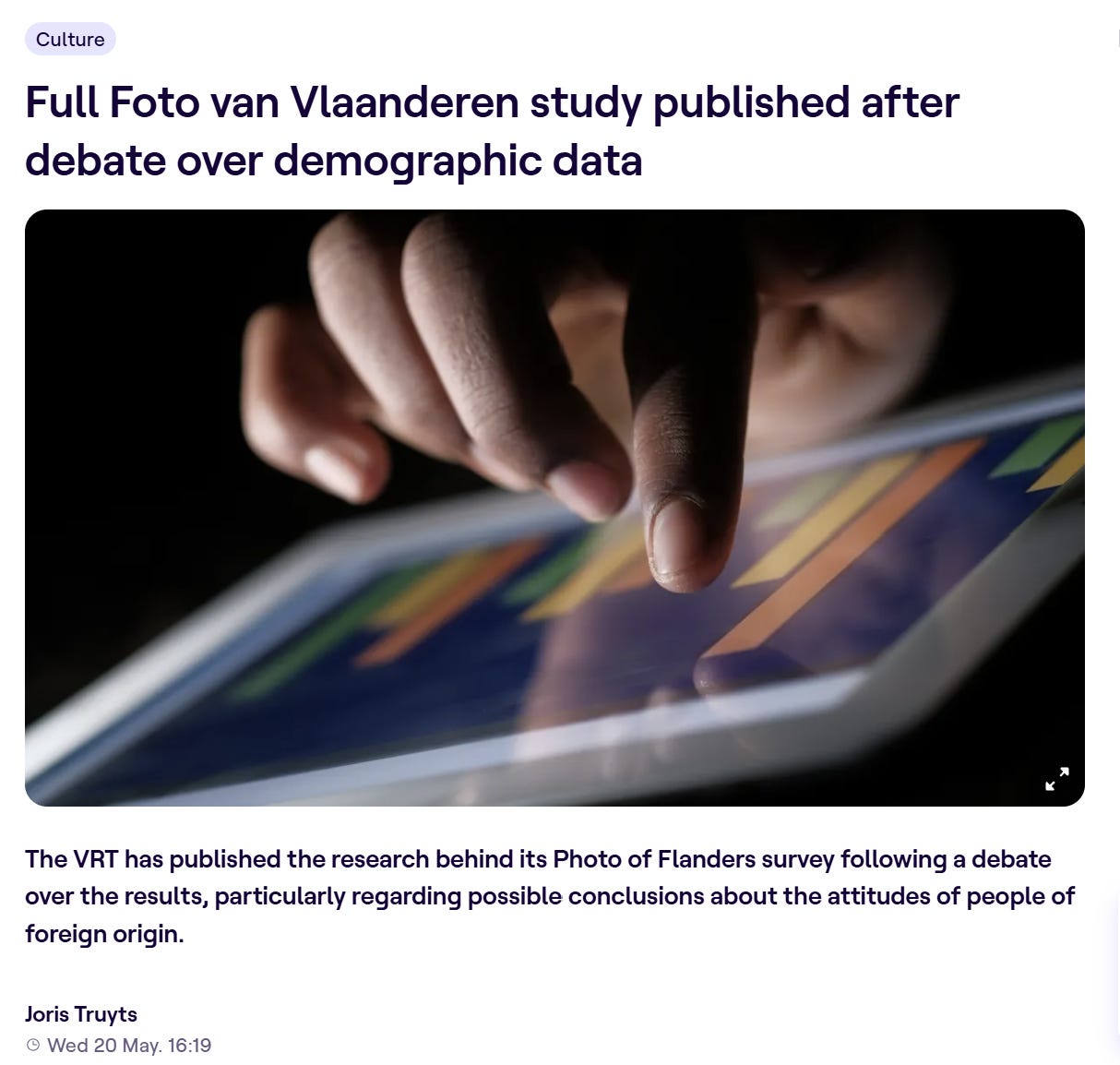
Guess what? VRT had indeed been sitting on statistically significant data about the role of migration and Islam all along, but had simply chosen not to release it. They had even created a separate category for respondents from the “North Africa and Middle East” region, containing 49 participants. Still a relatively small group, but more than enough to extract a clear signal from the statistical noise.
Here are Freek’s results, visualised by Claude, using a composite variable for “gender tolerance”:
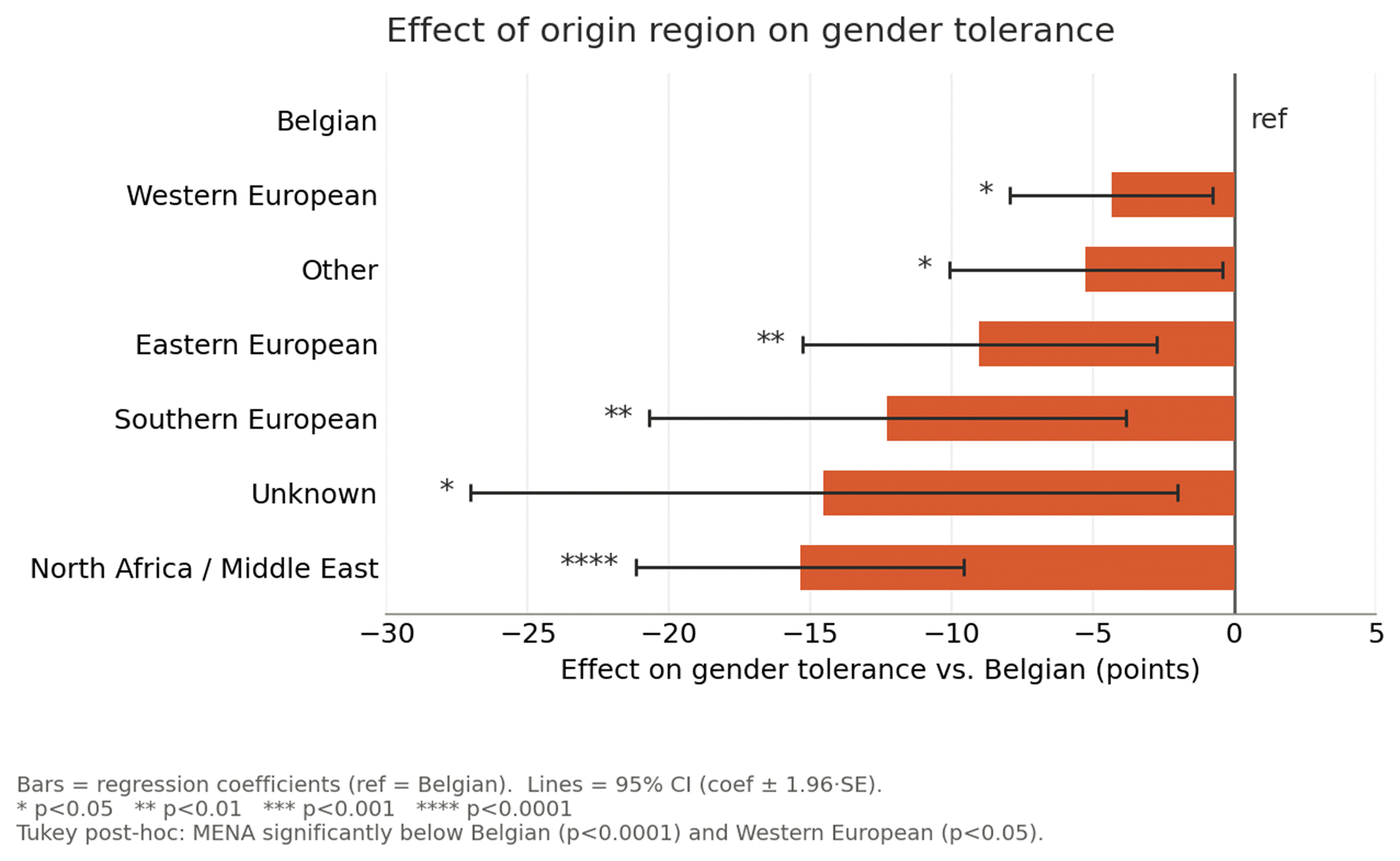
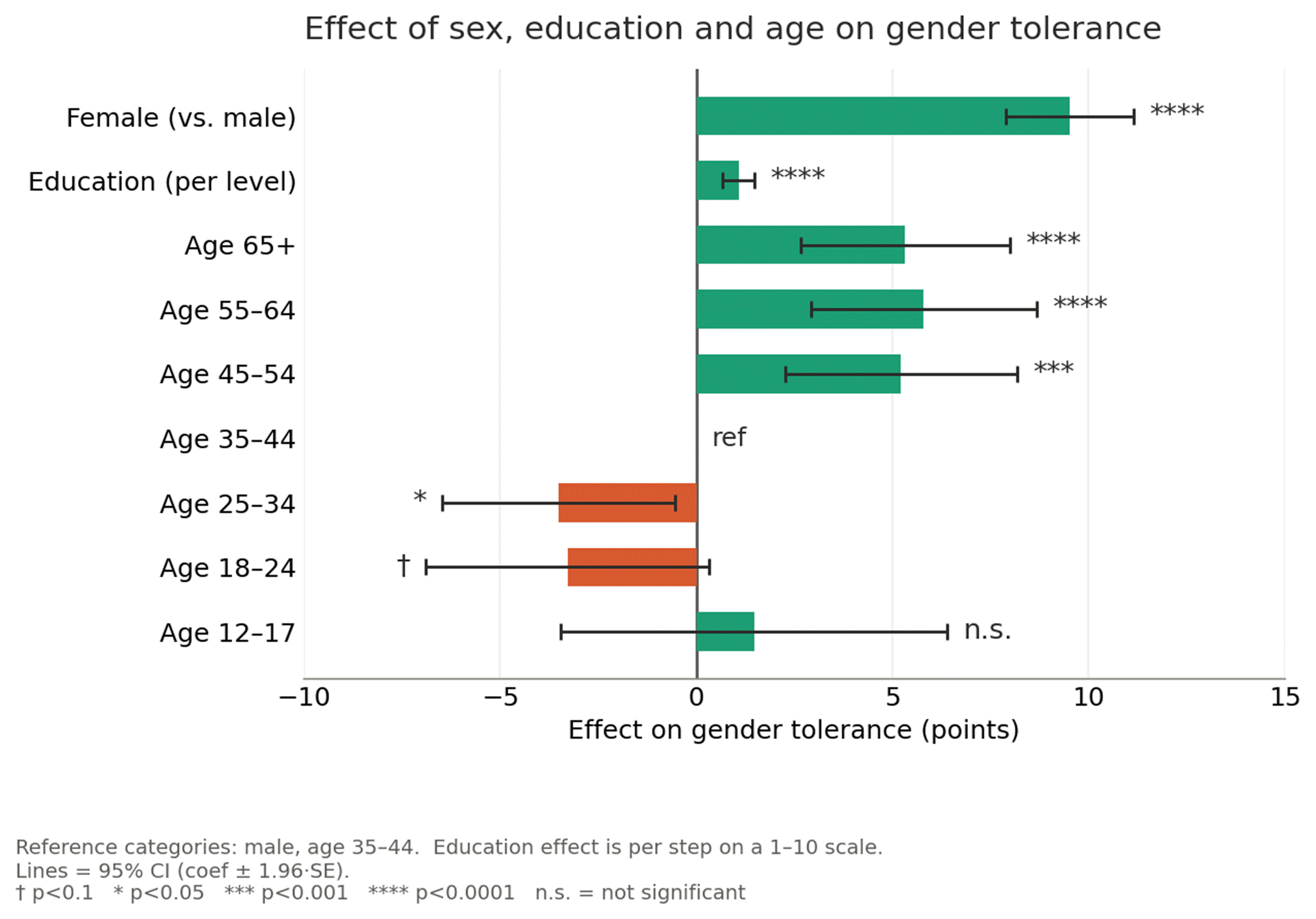
As you can see, the difference between native Belgians and the MENA group is large and statistically significant: people from the MENA region score more than 15 percentage points lower on gender tolerance. Coincidentally, that gap is larger than any of the age differences that received so much attention in the media coverage.
Fear of Islam
Naturally, the MENA region is only a proxy for Islam. Although roughly 95% of the region is Muslim (and there were no respondents from Israel anyway), we cannot rule out that some respondents were Christians, atheists, or members of other religious minorities. Moreover, third-generation immigrants are completely invisible in this methodology: they qualify as “pure Flemings”. Then there is the additional complication of religious converts.
The solution is obvious: VRT should have asked directly about religion! You cannot say anything meaningful about the effects of age and education without taking into account a factor that has repeatedly been shown to exert a huge influence on gender intolerance. Moreover, religion is a potential confounder for age effects, since Belgian Muslims are, on average, considerably younger than native Belgians—a consequence of recent migration and higher fertility rates. What may appear to be a generational effect can therefore partly reflect differences in religious composition. Or indirect social influences in the classroom.
As my friend the sociologist Ruud Koopmans told a Flemish magazine, the VRT’s neglect of religion is simply bonkers. “It’s as if you’re doing research into crime and you don’t ask about the gender of perpetrators and victims.” In other words, the erasure of the link between religion and LGBT intolerance was already baked into the study design itself, even apart from the later decision to bury the results in the reporting.
It’s not as if the study was uninterested in Islam and migration. Curiously, however, it was interested only in the prejudices of white native Flemings towards Muslims: fear of mosques, resistance to migration, anxieties about Islamisation, and concerns about the “Great Replacement”. They even thought the silly “winter markets” (rebranded Christmas markets) merited a question.
Ironically, this framing implicitly excludes Muslims from the category of “real Flemings”. After all, “fear of mosques” is hardly a meaningful question for someone who attends one every Friday. And why the hell would a Muslim care about rebranded Christmas markets?
Most egregiously, the survey treats the claim that “there are only two sexes” as a form of intolerance—an inability to handle gender diversity. Newsflash from biology: THERE ARE ONLY TWO SEXES (apologies for the caps; it’s my toxic male aggression flaring up).
How a spiral of silence works
What can we learn from this?
Anyone who has not been living under a rock for the past few decades knows that the link between Islam and gender intolerance is considered radioactive in much of academia and the press. Researchers prefer not to talk about it, not to include it in their research, and to downplay it when they stumble upon it despite their best efforts. What is rare is getting a glimpse behind the scenes when such decisions are made, as I happened to do.
But it is important to be precise about the social and psychological mechanisms behind political correctness and self-censorship. Many people imagine cover-ups as a bunch of individuals sitting in a smoke-filled room whispering conspiratorially: “We cannot release this—it would damage our political cause. Let’s just bury the data.”
Real motivated reasoning is far more subtle. It usually operates through a series of small decisions, each supported by a semi-plausible justification.
In this case, the people at VRT refrained from asking questions about religious faith, created a miscellaneous “foreign origin” category that was of limited analytical value to begin with, and were then relieved to discover a large number of Dutch respondents in the migrant group. That provided a convenient excuse to ditch the category altogether and focus instead on age effects and the divide between boys and girls.
Phew! No need to dig a little deeper, remove the Dutch (or other Western Europeans) from the sample, or examine regional differences, which would’ve instantly solved the alleged problem of “representativeness”. It is this convenient neglect and selective scrutiny that betrays bias. The youngest age groups suffered from similar problems—small samples, high dropout rates—but those findings did not offend political sensibilities, so they were allowed to stand.
After a lengthy meeting with representatives from VRT and the agency that collected the data (Profacts), I do not believe there was any deliberate deception on their part. Rather, what I saw was an accumulation of small decisions by the research bureau, the news desk, and the talking heads, each gently nudging the story away from sensitive findings and towards more palatable ones.
In a revealing moment, the VRT representative told us that the public broadcaster has a mission to be verbindend—a Dutch term that is difficult to translate, but roughly means “unifying” and “inclusive”. In VRT’s view, focusing on findings that might stigmatise certain groups in society sits uneasily with that mission (although apparently they were less concerned about stigmatising young boys).
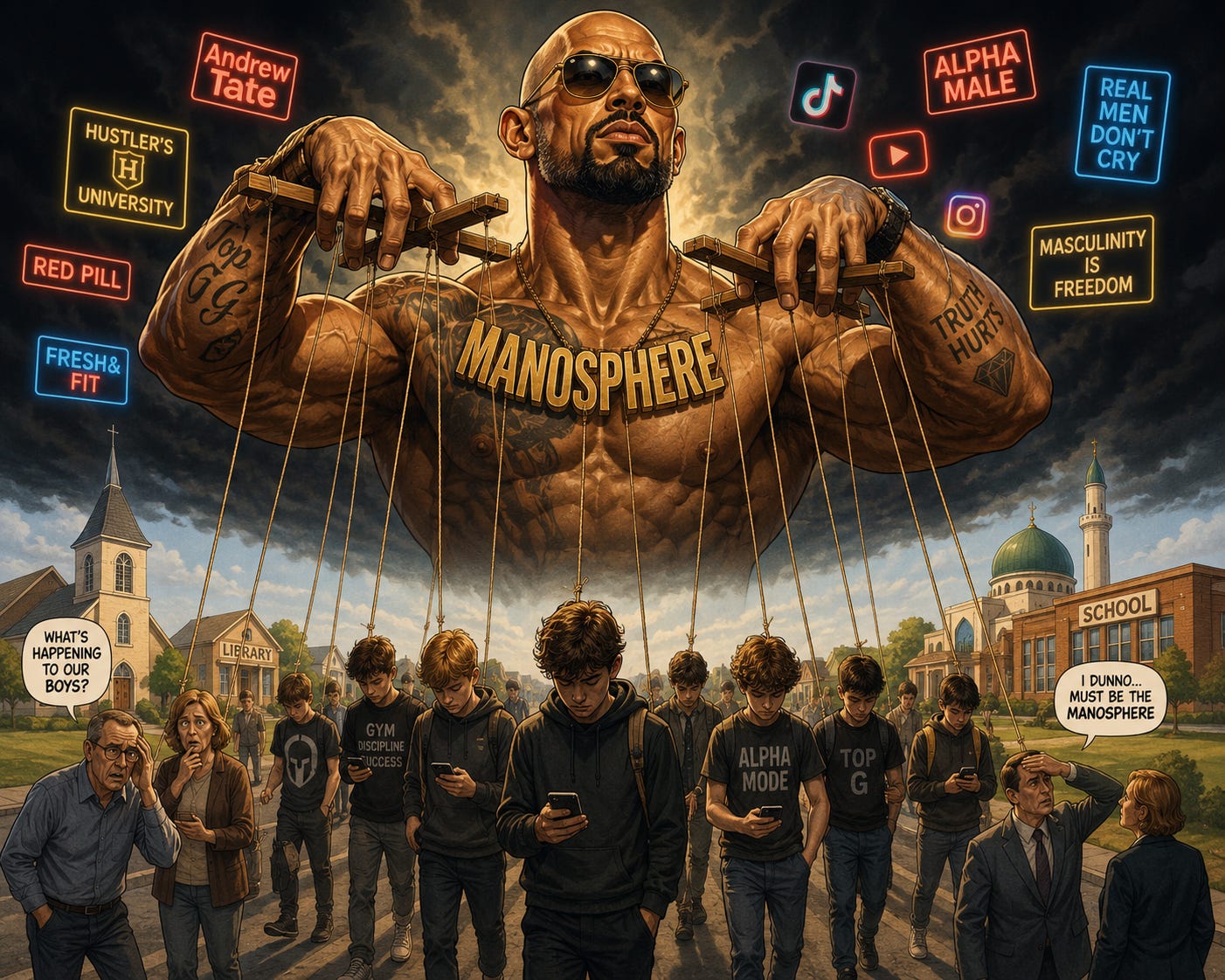
By the time the story reached the Flemish public, it had become a highly distorted—but politically convenient—story about the evils of the “manosphere”. Notice that this explanation is pure speculation, unsupported by the survey itself, which contained no questions about social-media consumption, familiarity with manosphere influencers, or anything of the sort.
But it fits neatly into a progressive narrative: it is all the fault of Andrew Tate and other toxic dudes. After all, who could doubt the horrors of the manosphere after watching the Netflix series Adolescence, which was fawned over by the liberal media for months?
Never mind that it was pure fiction and not remotely credible: a young boy (obviously white) from a warm and loving family suddenly turns into a monster after suffering romantic rejection and watching some misogynistic content online. The series can’t even tell the difference between the incel movement and the manosphere, which are largely distinct and often opposed to one another.
Yet the Flemish government loves the series so much that it wants to add it to the school curriculum. It’s a bit like teaching students about psychopathy and transgenderism by making them watch The Silence of the Lambs.

But series such as Adolescence are useful because they divert attention from factors that make liberals far more uncomfortable, such as religious fundamentalism imported through migration. Louis Theroux’s recent documentary Inside the Manosphere was similarly lazy and tailored to the expectations of his liberal audience (see this excellent piece in Quillette).
For much the same reasons, the VRT decided not to ask about religious faith, and to further “drown the fish” (as the French say) in a largely meaningless foreign-origin bucket.
By the way, Andrew Tate has recently converted to Islam, I’m sure that’s just a total coincidence?
Anyway, as you can imagine, all of this proved to be a considerable distraction from writing my book. It has occupied half of my time for the past two weeks. I wanted to share some dispatches about this affair, but now I really do have to get back to work.
I’m currently working on the seventh chapter, about the roots of anti-Western ideology, including an extensive section on the intellectual godfather of the concept of Islamophobia, Edward Said.
Stay tuned!
Thank you for having the courage to speak up publically. Most people would not have done that.
Well done, Maarten.